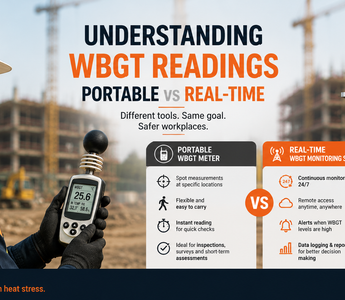
Explanation of Differences Between
Portable and Real-Time WBGT Readings
It is normal for a Portable WBGT Meter and a Fixed Real-Time WBGT Monitoring System to show slightly different readings, even when measurements are taken at the same general location.
WBGT readings are influenced by the immediate environmental conditions surrounding the sensors, including:
-
Measurement position and height
-
Direct sunlight and radiant heat exposure
-
Air movement and wind speed
-
Nearby structures, equipment or shaded areas
-
Sensor response and stabilization time
-
Instrument accuracy and measurement uncertainty
-
Sampling and averaging intervals
A fixed real-time WBGT monitoring system measures continuously at a permanent location and is already stabilized to the surrounding environmental conditions.
In comparison, a portable WBGT meter may have been moved from another location, carried indoors or transported in an air-conditioned environment before measurement. Its sensors, particularly the black globe sensor, require sufficient time to stabilize after being placed at the monitoring location.
Therefore, an immediate comparison between the two instruments may result in different readings.
Recommended Comparison Method
For a more meaningful comparison:
-
Position the portable WBGT meter as close as practically possible to the fixed monitoring system.
-
Ensure both instruments are at approximately the same height.
-
Ensure both instruments receive similar sunlight, radiant heat and airflow exposure.
-
Avoid placing one instrument in shade while the other is exposed to direct sunlight.
-
Allow the portable meter sufficient time to stabilize before recording the readings.
-
Compare readings over a period of time rather than relying on a single instantaneous reading.
-
Where possible, compare individual parameters such as air temperature, relative humidity and globe temperature, in addition to the calculated WBGT value.
Important Note
The two instruments are not expected to display exactly identical values at every moment.
Small differences may occur due to environmental variation, sensor response characteristics, measurement uncertainty and differences in data averaging.
The comparison should therefore be assessed against the manufacturer's specified accuracy and measurement uncertainty of each instrument, rather than expecting an exact 1-to-1 match.
A difference in readings alone does not indicate that either instrument is faulty, provided both instruments are properly calibrated and operating within their respective specifications.
For further information or assistance with comparing WBGT readings, please visit our website for more information or contact us directly.